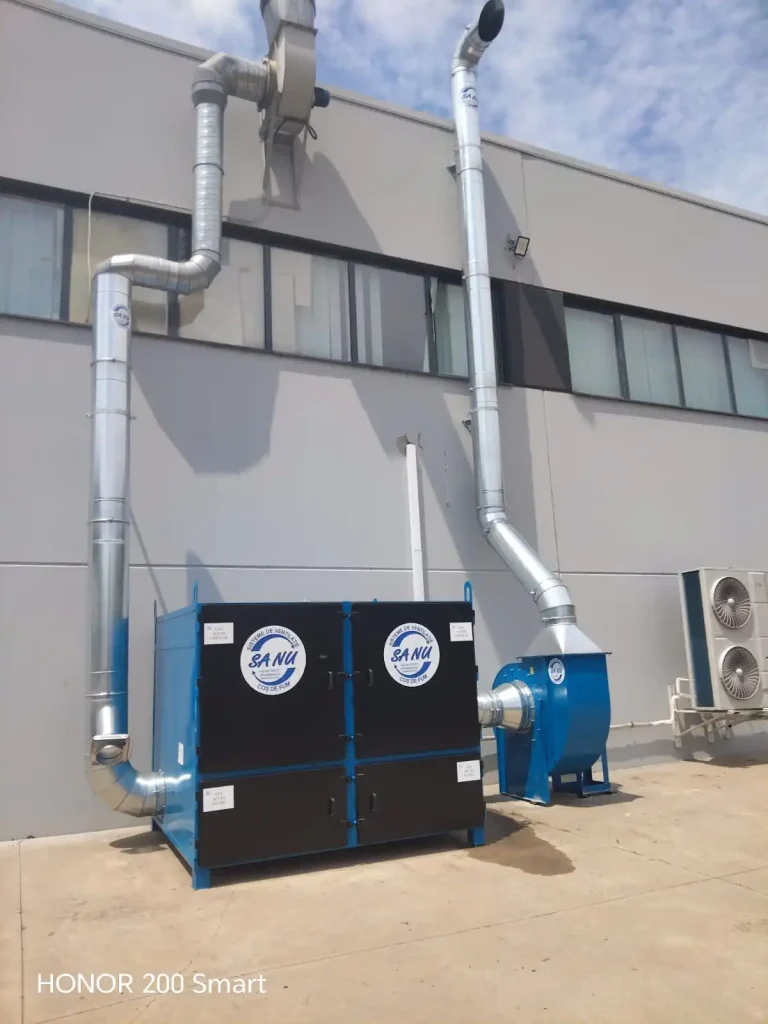
Stainless steel system for capturing and venting steam from the vegetable blanching area
Sanu Vent Project – Ialomița County
Application: Food canning plant


General Description
For a food canning plant in Ialomița County, Sanu Vent designed and built a complete system for capturing and venting the steam generated in the vegetable blanching area.
The manufacturing process generates significant amounts of steam and moisture, which, without effective ventilation, can adversely affect working conditions, equipment, and the structural components of the production facility.
The implemented solution ensures that steam is captured directly above the blanching tank, transported through a network of pipes, and discharged in a controlled manner above the building.
Main Components of the System
1️⃣ Industrial range hood made of food-grade stainless steel
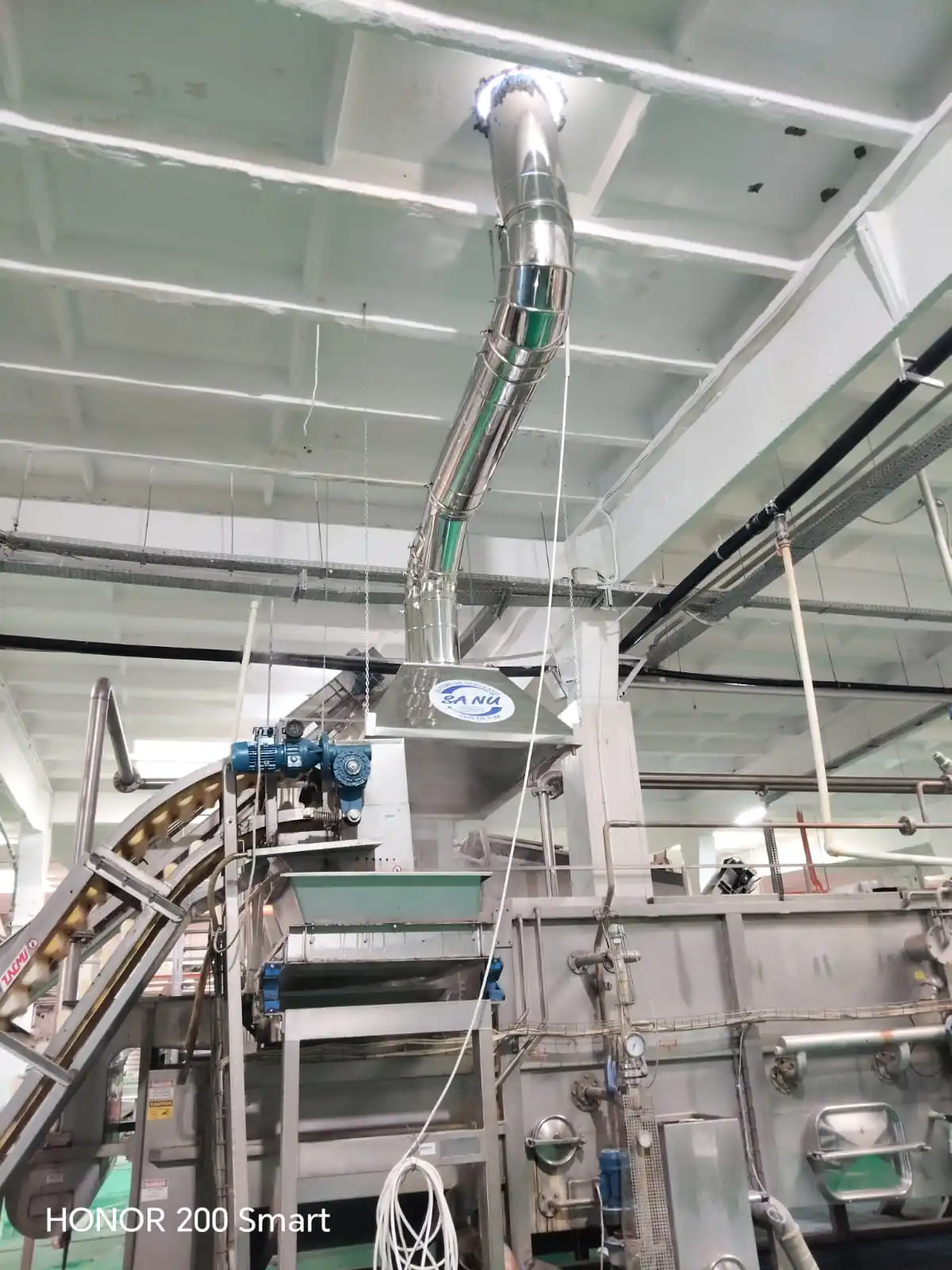
The facility is equipped with a fume hood made entirely of food-grade stainless steel, measuring 5.5 × 2 meters.
The hood was installed above the blanching tank and sized to efficiently capture the large amounts of steam generated during the production process.
Its shape and positioning help limit the dispersion of steam in the production area and direct it toward the exhaust system.
2️⃣ Stainless steel piping system
The captured steam is transported to the outside through a network of pipes made entirely of food-grade stainless steel.
According to the technical configuration of the facility, the intake connections have a diameter of Ø450 mm; they are connected to an intermediate section with a diameter of Ø600 mm and then to the main discharge line with a diameter of Ø750 mm.
The ductwork is sized to ensure efficient airflow and to reduce the risk of condensation and moisture buildup along the route.
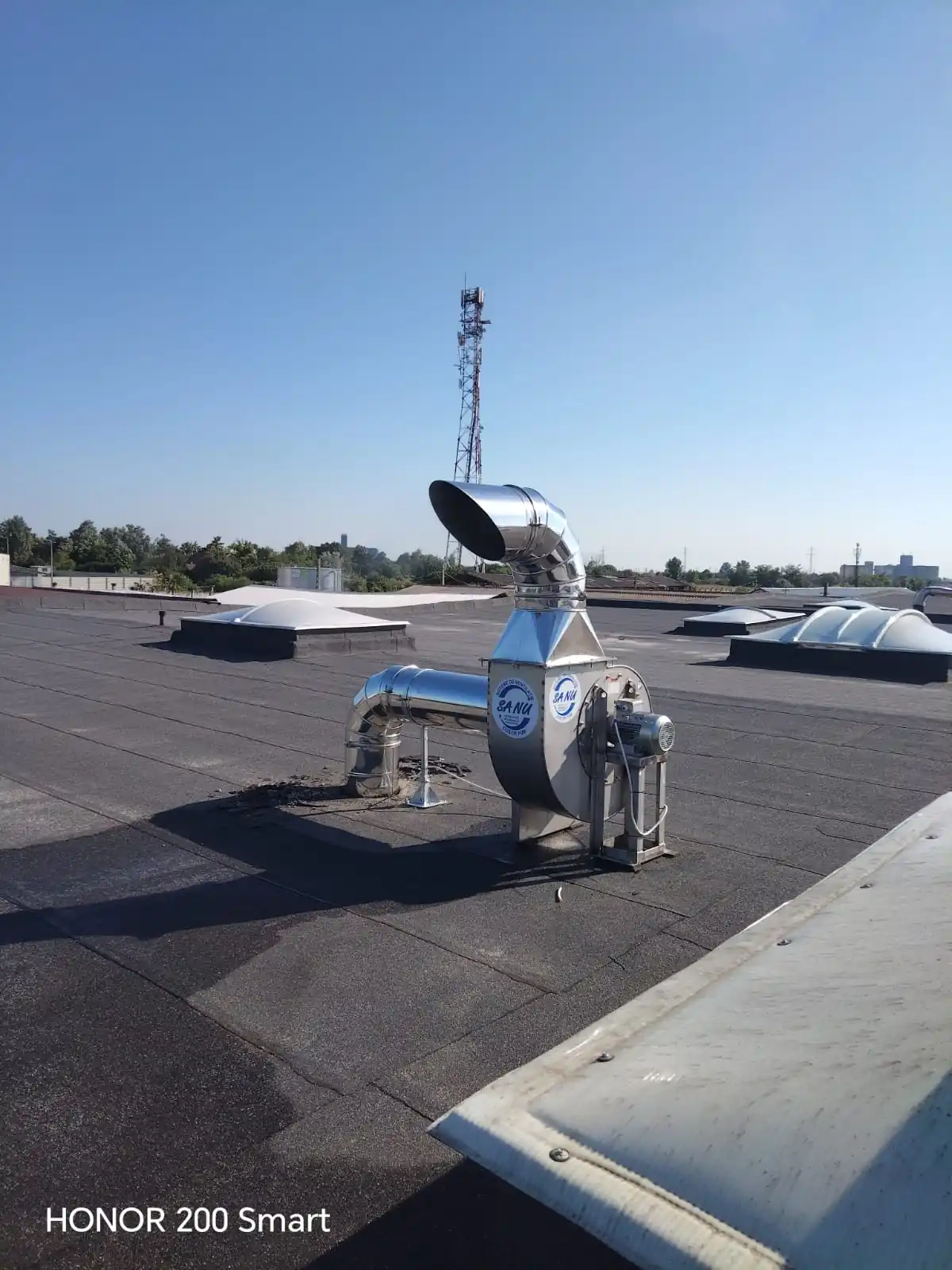
3️⃣ 18.5-kW centrifugal fan
Steam is exhausted using a GGE 802 centrifugal fan with an installed power of 18.5 kW and a speed of 1,400 rpm.
The fan was selected and sized to provide a total airflow of 29,700 m³/h, which is necessary for efficient vapor capture across the entire surface of the range hood.
The ventilation assembly maintains the necessary negative pressure in the system and ensures the constant removal of vapor-laden air.
4️⃣ Venting the air above the building
The ductwork system carries the steam-laden air up to the roof level, where it is vented in a controlled manner above the building.
The duct layout was designed to ensure proper dispersion of the exhaust air and to limit the recirculation of vapors into the production areas.
5️⃣ Made entirely of food-grade stainless steel
The entire unit—the range hood, the ductwork, the fan housing, the support frame, and the fan blade—is made of food-grade stainless steel.
Using this material offers:
- high resistance to corrosion and moisture;
- durability under conditions of intensive use;
- the ability to be easily sanitized and maintained;
- compliance with food industry-specific requirements;
- resistance to the temperatures and vapors generated during the manufacturing process.
Purpose and Benefits of the Facility
By implementing the capture and exhaust system, steam is collected directly from the generation area and removed before it disperses into the production hall.
The installation contributes to:
- reducing excessive humidity in the workspace;
- improving visibility and operator comfort;
- reducing condensation on surfaces and equipment;
- protecting the equipment and structural components of the facility;
- maintaining proper sanitary conditions;
- controlled discharge of a flow rate of up to 29,700 m³/h;
- compliance with the specific requirements of food industry processes.
Outcome of the project
Through this project, Sanu Vent delivered a complete and sustainable system for managing the steam generated during the vegetable blanching process.
The large industrial hood, the piping made entirely of stainless steel, and the 18.5 kW centrifugal fan form a single integrated system capable of efficiently capturing and exhausting the large amounts of steam generated during production.
The result is a safer and better-controlled work environment, as well as enhanced protection for the plant’s equipment and infrastructure.